

Web Application Security Testing
That Finds What
Scanners Miss
Web application security testing
Manual, Attacker-Led Testing for the Applications Your Business Runs On
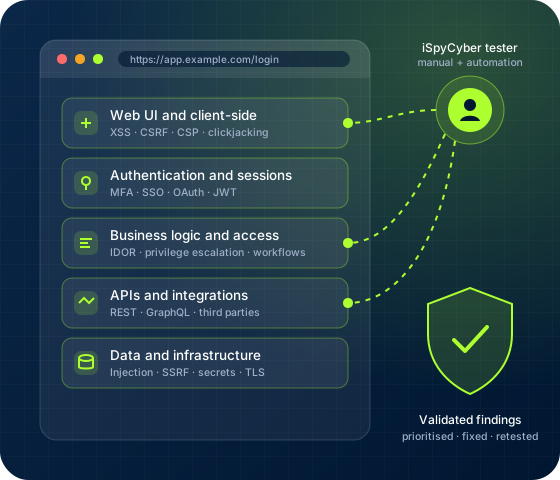
iSpyCyber combines expert manual penetration testing with targeted automation to uncover exploitable vulnerabilities in authentication, access control, business logic, APIs and integrations. Every finding is validated, risk-rated and delivered with remediation guidance your developers can act on immediately.
Why organisations choose iSpyCyber
Business-logic depth
We learn how your application is meant to work, then break those assumptions across workflows, pricing, approvals and multi-step transactions.
Role-by-role testing
Every user role is tested for horizontal and vertical privilege escalation, IDOR and broken object-level authorisation.
Near-zero noise
Automated output is triaged and reproduced by hand, so your team only receives real, exploitable issues.
Developer-ready fixes
Reproduction steps, proof-of-concept evidence and code-level remediation guidance for every finding.
Safe for production
Agreed rules of engagement, test windows and rate limits protect live services and customer data.
Continuous validation
Retesting confirms every fix, and iefyx, our AI-native VAPT platform, keeps exposure visible between engagements.
Coverage
What We Test in Your Web Applications
Our testers work through the full OWASP Web Security Testing Guide and go beyond it, chaining weaknesses the way real attackers do.
Authentication and sessions
Login, MFA, password reset, SSO, OAuth and SAML flows, session tokens and JWT handling.
Access control
Horizontal and vertical privilege escalation, IDOR, forced browsing and multi-tenant isolation.
Injection flaws
SQL, NoSQL, OS command, template and LDAP injection across every input, header and parameter.
Business logic
Workflow bypass, price and quantity tampering, race conditions and abuse of legitimate features.
APIs behind the app
REST and GraphQL endpoints, mass assignment, rate limiting and excessive data exposure.
Client-side security
Stored, reflected and DOM-based XSS, CSRF, clickjacking, CORS and Content Security Policy.
Files, SSRF and XXE
Upload validation, path traversal, XML external entities, insecure deserialisation and server-side request forgery.
Data protection
TLS configuration, sensitive data exposure, secrets in client code and weak cryptography.
Configuration and components
Security headers, error handling, outdated frameworks and vulnerable third-party libraries.
Methodology
A Proven Six-Phase Testing Methodology
Aligned to the OWASP Web Security Testing Guide, OWASP ASVS and NIST SP 800-115, and tailored to your architecture, users and risk.
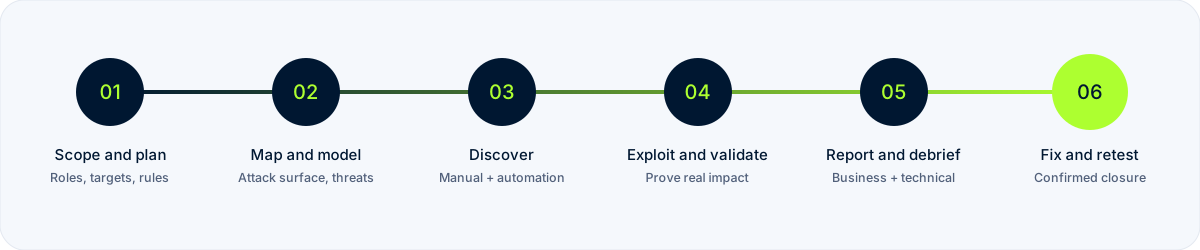
01. Scope and plan
Applications, user roles, environments, test windows and success criteria agreed up front.
02. Map and model
Reconnaissance and threat modelling of the attack surface, technologies and high-value workflows.
03. Discover
Targeted automation combined with hands-on testing of every role, function and integration.
04. Exploit and validate
Impact safely proven, vulnerabilities chained and false positives eliminated.
05. Report and debrief
Executive summary, technical findings and a live walkthrough with your engineering and leadership teams.
06. Fix and retest
Remediation guidance, developer Q&A and retesting to confirm every issue is closed.
Engagement models
Choose the Testing Approach That Fits Your Risk
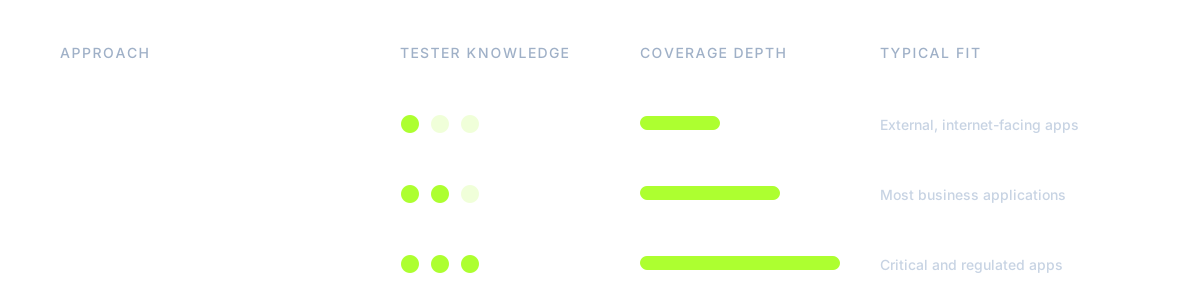
Every approach uses the same methodology. The difference is how much context our testers start with, and how deep they can go.
Black box
No prior knowledge, simulating an external attacker against your public application. Best for internet-facing applications and validating external exposure.
Grey box
User credentials and limited documentation to test authenticated attack paths across roles. Best for most business applications, with the strongest balance of depth and efficiency.
White box
Source code, architecture and administrative access for the deepest coverage. Best for critical applications, major releases and regulated workloads.
Not sure which approach you need?
Our specialists will recommend a scope based on your architecture, users and compliance obligations.
Deliverables
Reports Built for Leadership, Engineering and Auditors
Clear business context for decision-makers, precise technical detail for developers and evidence your auditors can rely on.
Executive summary
Overall risk posture, key themes and business impact in plain language for leadership and boards.
Technical findings
Every vulnerability with CVSS rating, affected assets, reproduction steps and proof-of-concept evidence.
Remediation roadmap
Prioritised, code-level fix guidance so teams resolve the highest-impact issues first.
Retest report
Independent confirmation of which findings are closed, ready to share with customers and auditors.
Supports your compliance and assurance requirements
- OWASP Top 10
- OWASP ASVS
- OWASP WSTG
- PCI DSS
- ISO/IEC 27001
- SOC 2
- DPDP Act 2023
- CERT-In guidelines
- NIST SP 800-115
- HIPAA
- GDPR
iSpyCyber provides independent security testing that supports these requirements. Certification and attestation are issued by accredited bodies and licensed auditors.
Web application testing for every industry
FAQ
Web application security testing questions, answered
Can’t find what you need? Talk to our security team.
The basics
What is web application security testing?
Web application security testing is a structured assessment, led by skilled testers, that identifies and safely exploits vulnerabilities in a web application, its APIs and supporting infrastructure, then explains the business impact and how to fix each issue.
How is it different from a vulnerability scan?
Scanners detect known patterns. Our testers validate every result, remove false positives and find what scanners cannot, such as broken access control, business logic flaws and chained attacks.
Which standards does your methodology follow?
Our methodology aligns with the OWASP Web Security Testing Guide, OWASP ASVS, the OWASP Top 10 and NIST SP 800-115, and findings are rated using CVSS.
Working with us
How long does a web application penetration test take?
Most engagements take one to three weeks, depending on the number of applications, user roles and integrations in scope. We confirm the timeline during scoping.
Will testing affect our live application?
We agree rules of engagement, test windows and rate limits before testing begins, and can test in staging environments that mirror production to avoid disruption.
Do you retest after we fix the issues?
Yes. We retest remediated findings and issue an updated report confirming which issues are closed.
How often should we test our web applications?
At least annually and after major releases, architecture changes or new integrations. Many clients combine periodic tests with continuous validation through iefyx.
Get started
Ship Secure Applications.
Without Slowing Delivery.
Talk to our application security specialists about a scoped web application penetration test for your environment.
- ISO/IEC 27001 and ISO 9001 certified
- 40+ enterprise and government clients
- 15+ countries